2-Way Tote Shuttle
AS/RS System

Single-axis shuttle carrier for deep-lane tote buffer storage. Lower cost than 4-way, ideal for high-volume FMCG buffer stores and applications where lane-by-SKU organisation is sufficient.

250
Cycles/hr per carrier
60m
Max lane depth
-25°C
Cold chain rated
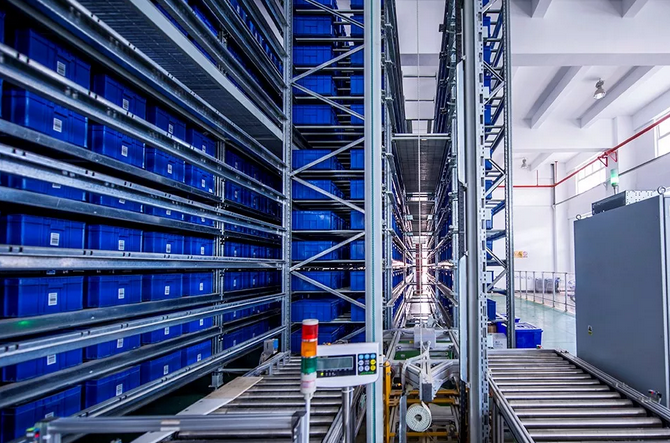
2-Way tote shuttle ASRS — deep lane single-axis tote storage system

Single-Axis Deep-Lane Buffer Storage

The 2-way (single-axis) tote shuttle operates along one lane row at a time. The carrier travels in and out along the rail of its assigned lane — simple, reliable, and 20–35% lower in system cost than a 4-way configuration. Each carrier is assigned to a specific lane group by the WCS and serves those lanes sequentially.

Best suited for warehouses with a relatively small number of active SKUs stored in large quantities per lane. Typical use cases: FMCG buffer stores sorting finished goods before dispatch, beverage DC pre-sort zones, bakery finished-goods buffers, and any application where throughput is under 300 cycles/hr per zone and lane-based organisation is sufficient.

A 2-way system can be upgraded to 4-way at a later stage by adding cross-aisle rail infrastructure and updating the WCS routing logic — making it an attractive entry-level investment for growing operations.

Tote shuttle buffer storage warehouse
20–35%
Lower cost vs 4-way
FIFO/LIFO
Configurable mode
4-Way
Upgrade path available

How the 2-Way Tote Shuttle Works

1

Tote Arrives at Lane Entrance

A tote is delivered to the infeed roller at the entrance of the target lane. WCS assigns the carrier to that lane and dispatches it to the infeed point.

2

Carrier Engages Tote

The carrier extends its lifting forks, picks up the tote from the lane entrance roller, and begins travelling inward along the X-axis rail at up to 3 m/s.

3

Position & Deposit

Encoder positioning locates the first empty slot (LIFO) or the deepest available position. Carrier lowers forks to deposit the tote and reverses back to the lane entrance.

4

Retrieval to Outfeed

On WCS retrieval command, carrier travels to the target tote, lifts and brings it to the lane entrance outfeed roller — ready for onward conveyor transport to the pick station.

Where the 2-Way Shuttle Excels

💰

Lower System Cost

No cross-aisle rail, fewer carriers required per zone, simpler WCS routing logic. Delivers 20–35% cost saving versus a comparable 4-way system for low-to-medium throughput applications.

📏

Very Deep Lane Capability

Lane depth up to 60m — suitable for very long storage bays where 4-way cross-aisle travel would add unnecessary complexity. One carrier can serve an entire deep lane without repositioning.

🔄

FIFO or LIFO

LIFO for production buffer stores where date rotation isn't required. FIFO configured by reversing carrier retrieval sequence — suitable for food and pharma products with expiry dates.

📈

4-Way Upgrade Path

System infrastructure is designed for future cross-aisle rail addition. When throughput outgrows 2-way capacity, upgrade to 4-way by adding Y-axis rails and updating WCS routing — no racking replacement.

❄️

Cold Chain Ready

Cold-rated carriers with heated battery compartments operate reliably at -25°C for chilled and frozen food buffer storage — a common application in FMCG and food retail DC pre-sort zones.

🔌

WCS Integration

WCS manages carrier assignment, lane sequencing, and FIFO/LIFO logic. Integrates with host WMS via TCP/IP or REST API for task-driven operation fully embedded in your warehouse workflow.

Specifications

Load typeTote / bin 600×400mm standard; other sizes on request
Max load per tote30–50 kg
Travel axisX-axis only (single-axis / 2-way)
Carrier speed2.0–3.0 m/s
Positioning accuracy±3 mm
Lane depthUp to 60m per lane
Storage modeFIFO or LIFO (WCS configurable)
Carriers per lane group1 carrier per 2–4 lanes (shared)
Max racking heightUp to 25m
BatteryLi-ion; heated compartment available for cold chain
Battery runtime8–10 hr per charge
Temperature range-25°C to +40°C
WMS integrationTCP/IP socket, REST API
Upgrade pathCompatible with 4-way cross-aisle rail addition

2-Way Shuttle Questions

When should I choose 2-way over 4-way?+
Choose 2-way when: (1) your SKU count per zone is low — each lane holds one SKU, so cross-aisle random access isn't needed; (2) your throughput is under 300 cycles/hr per zone; (3) your lanes are very deep (20–60m), where the extra lane depth suits 2-way well; and (4) budget is the primary constraint and you're willing to accept lower throughput in exchange for lower cost. Choose 4-way when you need fast random-access retrieval across many SKUs, high throughput (500+ cycles/hr), or goods-to-person pick station integration.
Can I upgrade to 4-way later without replacing the racking?+
Yes — if the system is designed with the upgrade path in mind from the start. The key additions required are: Y-axis cross-aisle rails at the ends of each storage row, updated 4-way capable carriers (which have the Y-axis travel mechanism), and WCS software update to enable cross-aisle routing. The main racking structure, vertical lifts, and I/O conveyors remain the same. Econocontrol designs 2-way systems with this upgrade path as a standard option — confirm the upgrade path requirement at the RFQ stage so the racking layout is optimised accordingly.
What industries use 2-way tote shuttle systems?+
Primary applications include: FMCG finished-goods buffer stores (one SKU per lane, LIFO, high throughput one direction at a time); food and beverage DCs with product pre-sort zones before dispatch; bakery and dairy operations with short shelf-life products requiring FIFO; and any production facility that needs a compact automated buffer between production and outbound logistics. The 2-way system is also common in cold chain dairy DCs where deep lanes are used to maximise density in a tight cold room footprint.

Related Products

Get a 2-Way Shuttle Quote

Share your tote count, lane depth, throughput, and temperature — we respond within 24 hours.