Shuttle & AS/RS Product Range
All systems are sourced from certified manufacturers and configured for your specific load, throughput, racking height, and temperature requirements.
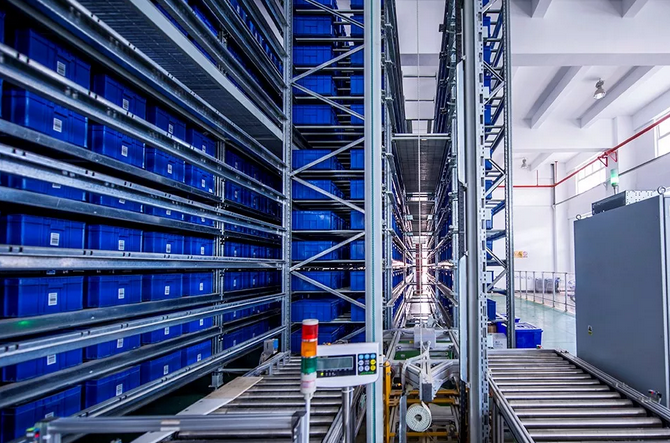
Transporte de 4 vías
Dual-axis carrier for totes & bins — up to 500 cycles/h, 30 m lane depth, cold storage rated.
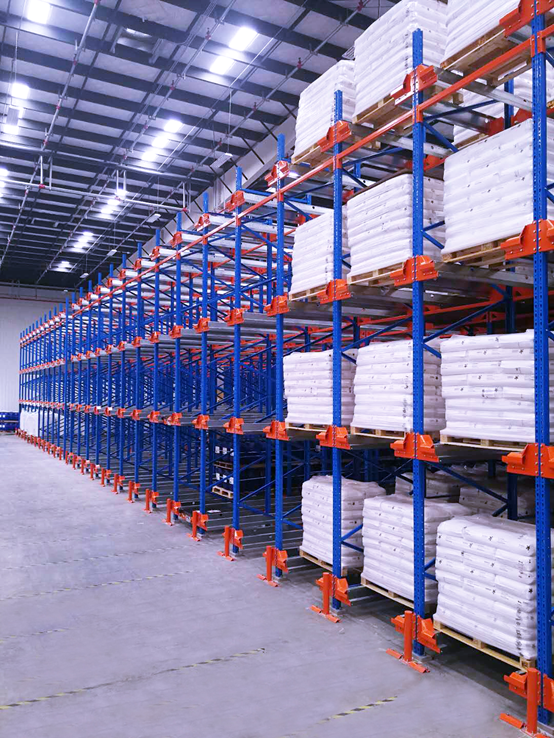
Transbordador de palés de 4 vías
Full-pallet 4-way carrier — 400 pallets/h, cold chain package, 3–4× density vs drive-in.
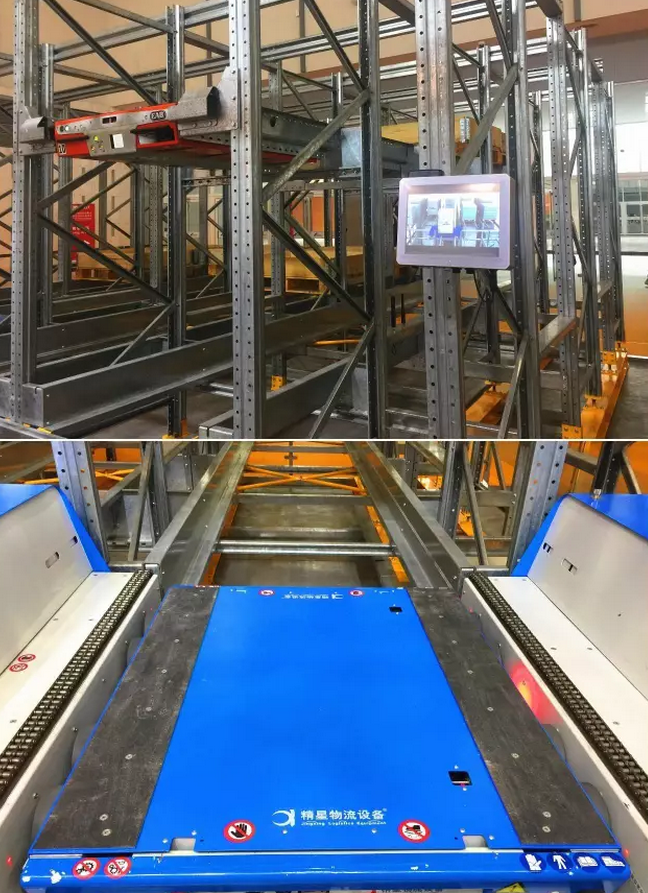
Estanterías para lanzaderas de radio
Remote-control carrier in drive-in racking — 30+ pallets deep, 8–10 h battery, 25–30% density gain.
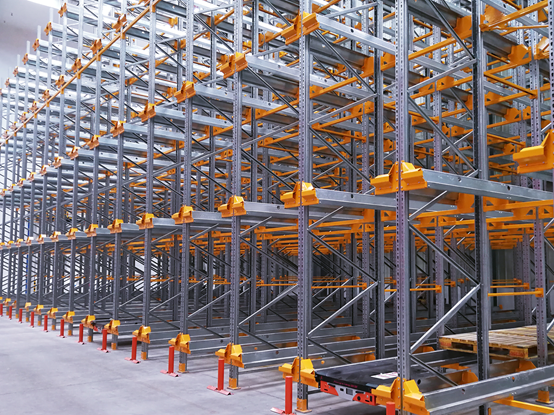
2-Way Tote Shuttle
Single-axis deep-lane buffer — 250 cycles/h, 60 m lane depth, 20–35% lower cost than 4-way.
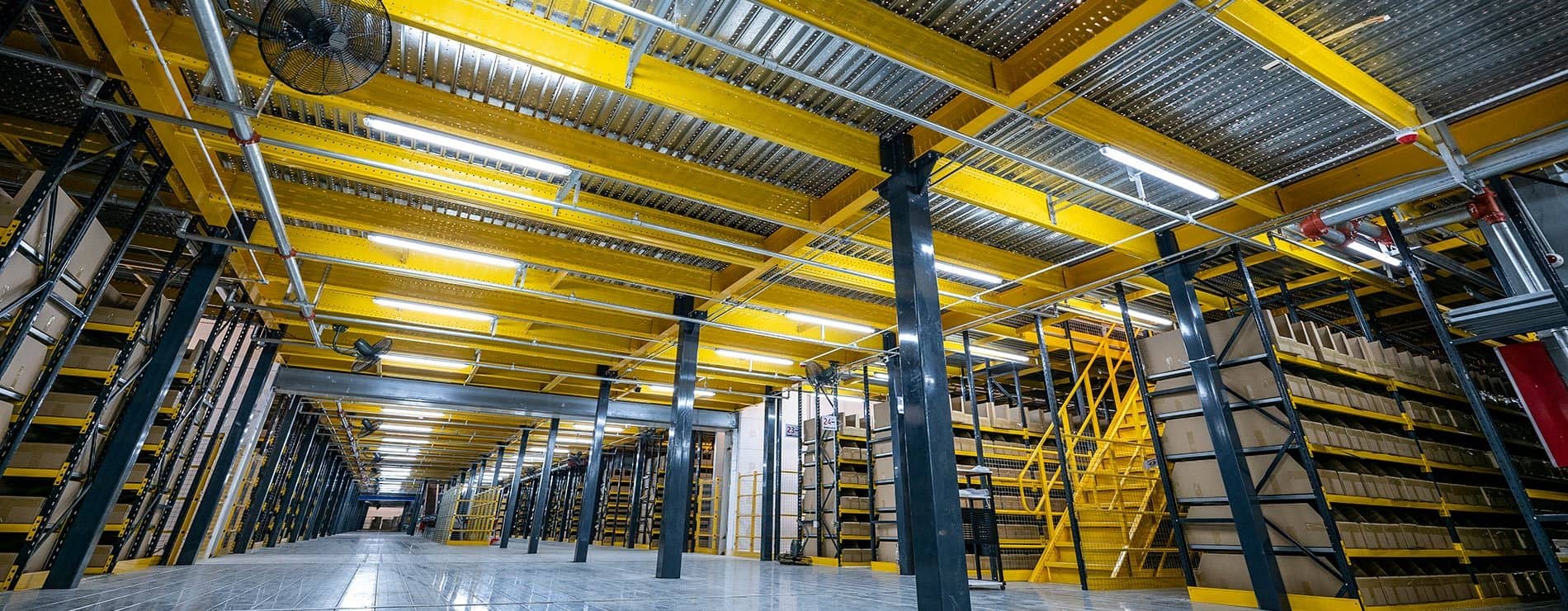
Bus / Attic Shuttle
Shared bus lift (1:6 ratio) — 500 totes/h, 40% less lift infrastructure vs individual hoists.
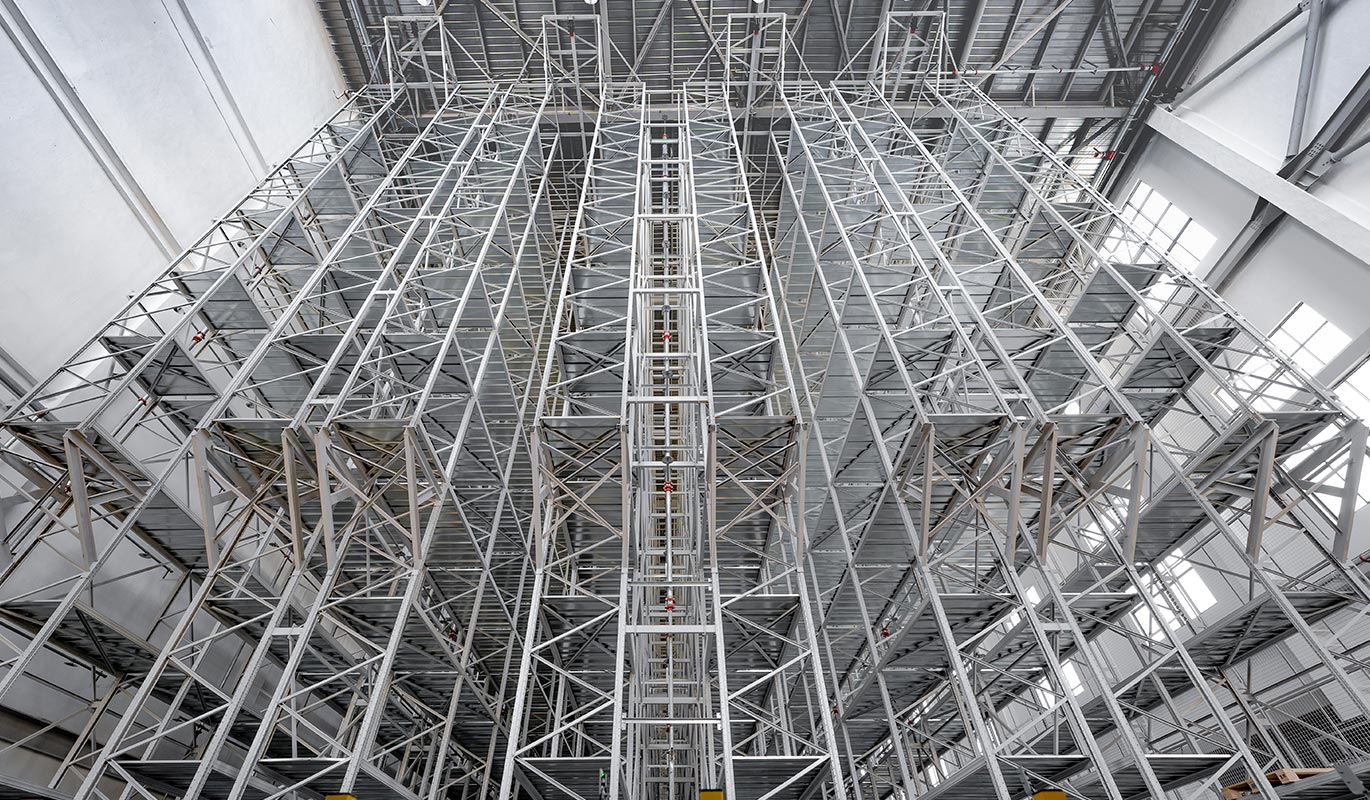
Grúa apilable AS/RS + EMS
High-bay stacker crane — 45 m height, ±5mm accuracy, 30% regen energy, EMS shuttle add-on.
Transporte de 4 vías System
Más Popular -25°C nominalDual-axis autonomous carrier · Multi-level · Goods-to-Person ready
El 4-way tote shuttle is the highest-performance compact-load AS/RS system available. Each shuttle carrier travels autonomously on both X-axis (along the storage row) and Y-axis (cross-aisle), using onboard laser distance sensors for precise positioning to ±2mm. This allows a single carrier to serve every storage location on its level without returning to a fixed aisle — fundamentally different from older 2-way systems.
Multi-level deployments use dedicated vertical lifts (one per aisle end) to move carriers between levels, while I/O conveyors connect the racking system to goods-to-person pick stations. A WCS (Warehouse Control System) orchestrates carrier routing, lift scheduling, and conveyor sequencing in real-time. Systems typically run 4–12 carriers per level with fleet sizes of 20–200+ carriers depending on throughput requirements.
Principio de funcionamiento
Carrier enters storage row → laser-guided positioning → extends fork to raise tote → traverses to cross-aisle rail → travels to vertical lift → delivered to I/O conveyor at pick station. Full cycle: 30–60 sec depending on travel distance.
| Load type | Tote / bin / tray |
| Standard tote size | 600×400mm, 400×300mm options |
| Max load / tote | 30–50 kg |
| Carrier speed (X/Y) | 3.0 / 2.5 m/s (unladen) |
| Precisión de posicionamiento | ±2 mm |
| Throughput (per carrier) | 300–500 cycles/hr |
| Lift speed (vertical) | 1.5–2.0 m/s |
| Racking height | Up to 30m (multi-level) |
| Storage levels | 4–20 levels typical |
| Batería | Li-ion, auto-charge at rail end |
| Temperature range | -25°C to +40°C |
| WMS integration | TCP/IP, REST API, OPC-UA |
2-Way Tote Shuttle System
Cost-Effective Buffer StorageSingle-axis carrier · Deep lane · FIFO or LIFO · Retrofit compatible
El 2-way (single-axis) tote shuttle operates along one row at a time, assigned to a specific storage lane by the WCS. It travels in and out along a fixed rail, making it simpler in construction and 20–35% lower in cost than a 4-way system. Best suited to warehouses with fewer active SKUs, deep storage lanes, and applications where FIFO (First-In First-Out) or LIFO buffer management is the primary objective rather than random-access throughput.
A 2-way system can be upgraded to 4-way by adding cross-aisle rail infrastructure — making it a logical entry-level choice for operations expecting to grow. Systems typically use one carrier per 2–3 aisles at lower throughput, reducing carrier count and WCS complexity versus 4-way deployments.
Best Application
FMCG buffer stores, beverage/dairy DC pre-sort, bakery finished goods buffer — high-volume, low-SKU operations where lane-by-SKU organization is sufficient and throughput is under 200 cycles/hr per aisle.
| Load type | Tote / bin 600×400mm |
| Max load / tote | 30–50 kg |
| Carrier speed | 2,0–3,0 m/s |
| Throughput (per carrier) | 150–250 cycles/hr |
| Lane depth | Up to 60m |
| Storage mode | FIFO or LIFO (configurable) |
| Racking height | Up to 25m |
| Carrier count | 1 per 2–3 aisles (shared) |
| Precisión de posicionamiento | ±3mm |
| Batería | Li-ion, 8–10 hr per charge |
| Temperature range | -25°C to +40°C |
| Upgrade path | Compatible with 4-way rail add-on |
Transbordador de palés de 4 vías System
Cold-Chain Ready 1.500 kilosHeavy-duty dual-axis · Full pallet automation · -25°C deep freeze rated
El 4-way pallet shuttle is the heavy-duty equivalent of the tote shuttle system, designed for full Euro and industrial pallets up to 1,500kg. El carrier uses a scissors-lift or chain-lift mechanism to raise the pallet, then traverses both along the storage row and across the aisle to access any pallet position in the racking. Laser ranging provides ±5mm positioning accuracy for reliable pallet fork insertion.
For cold chain applications at -18°C to -25°C, the carrier is equipped with a heated battery compartment, low-temperature lithium battery chemistry (operational down to -30°C), and NSF H1 food-grade lubricants on all bearing surfaces. El racking steel uses hot-dip galvanized profiles to resist moisture condensation corrosion in freeze-thaw cycles. Paired with cold-rated VFDs on the I/O conveyors, this creates a complete freeze-rated AS/RS system.
Cold Chain Advantage
4-way pallet shuttles increase storage density 3–4× vs drive-in forklift racking in the same building footprint — directly reducing refrigerated building volume and energy cost. Fewer door openings maintain stable cold room temperature.
| Pallet size | 1200×1000 / 1000×1200 mm (Euro) |
| Max load / pallet | 1.500 kilos |
| Carrier speed (X/Y) | 1.5 / 1.2 m/s loaded |
| Precisión de posicionamiento | ±5mm |
| Throughput | 200–400 pallets/hr (multi-carrier) |
| Lift mechanism | Scissors / chain lift |
| Racking height | Up to 25m |
| Batería (cold-rated) | Li-ion -30°C, heated compartment |
| Lubricación | NSF H1 food-grade option |
| Temperature range | -25°C to +40°C |
| Racking material | Hot-dip galvanized or SS available |
| WMS integration | TCP/IP, OPC-UA, REST API |
Estanterías para lanzaderas de radio System
Retrofit Friendly Semi-AutomaticRF remote controlled · Drive-in replacement · LIFO or FIFO · Lowest entry cost
El radio shuttle is a semi-automated pallet storage solution that replaces conventional drive-in racking while using existing forklift operations. A remotely-controlled carrier vehicle (the "shuttle") rides on rails inside a deep storage lane. El forklift operator places the shuttle into the desired lane via RF remote or tablet app; the shuttle automatically travels to the optimal storage position and deposits or retrieves the pallet autonomously.
El primary advantage is eliminating the need for a forklift to drive inside the racking structure — a major source of racking damage and safety incidents in conventional drive-in setups. Radio shuttles also achieve 25–30% more pallet positions in the same footprint versus drive-in racking because no forklift clearance is needed between pallets. FIFO (First-In First-Out) layouts are available using a dual-entry lane configuration.
Key Advantage vs Drive-In
No forklift enters the racking bay. Zero racking upright damage from forklift collisions — one of the most common and costly warehouse maintenance issues. Carrier navigates using ultrasonic sensors and onboard encoders for lane-end detection.
| Tipo de palet | Standard EUR / ISO pallets |
| Max load / pallet | 1.500 kilos |
| Carrier speed (loaded) | 0.6–1.0 m/s |
| Carrier speed (unladen) | 1.2–1.5 m/s |
| Lane depth | 5–30+ pallets deep |
| Storage mode | LIFO (standard) / FIFO (dual-entry) |
| Control | RF remote + optional tablet app |
| Batería | Li-ion / lead-acid, 8–10 hr |
| Charge time | 2–3 hr full charge |
| Racking height | Up to 12m |
| Temperature range | -25°C to +40°C |
| Navegación | Encoder + ultrasonic lane-end sensors |
Bus Shuttle & Attic Shuttle System
Space Efficient Mid-HeightCentral lift car (bus) · No per-level elevators · Mezzanine integration
El bus shuttle system uses a central "bus" car — a single vertical lift vehicle that travels between all storage levels, carrying shuttle carriers from level to level. Unlike conventional multi-level shuttle systems that require a dedicated lift at every aisle end, the bus approach uses one shared lift per zone, significantly reducing infrastructure cost in mid-height warehouses (6–18m, 4–8 levels).
El attic shuttle variant is designed specifically for mezzanine warehouses where a storage deck is installed above an existing facility. Attic shuttles operate in the upper storage zone while pick stations remain on the ground floor. El shuttle feeds totes down to a gravity conveyor or belt system for retrieval. This configuration is popular in 3PL and food retail DCs where vertical space exists but full ASRS capital investment is not yet justified.
Bus vs Elevator ASRS
A bus shuttle system uses 1 lift per 4–6 storage aisles (shared lift). A full elevator ASRS uses 1 lift per 1–2 aisles. Bus systems reduce lift infrastructure cost by 40–60% at the expense of some throughput — ideal for operations under 500 tote movements/hr.
| Storage levels | 2–12 levels |
| Warehouse height | 6–18m (bus) / 4–8m (attic) |
| Bus lift speed | 1.0–1.5 m/s |
| Shuttle speed | 2,0–3,0 m/s |
| Lifts per system | 1 bus per 4–6 aisles |
| Throughput | 100–500 totes/hr (system) |
| Load type | Tote 600×400mm standard |
| Max load / tote | 50 kg |
| Pick station interface | Ground-level I/O conveyor |
| Temperature range | 0°C a +40°C (estándar) |
| WMS integration | TCP/IP, REST API |
| Footprint vs elevator | 30–40% less lift infrastructure |
Grúa apilable AS/RS & EMS Shuttle
High-Bay Specialist Up to 45mSingle-mast stacker crane · Very tall warehouses · EMS overhead monorail
El stacker crane (stack crane) AS/RS is the industry standard for very tall, high-capacity warehouses — typically 15m to 45m in height. Each crane unit runs on a floor rail in a dedicated narrow aisle (900–1,200mm) with a mast-guided load handling device (LHD) that raises and lowers to access any storage level. A single crane serves one aisle, with cranes operating in parallel across multiple aisles coordinated by the WCS.
Stack cranes use absolute position encoders (or laser measurement systems) for horizontal travel and mast-mounted absolute encoders for vertical position — achieving positioning accuracy of ±5mm at heights up to 45m. Modern cranes use regenerative braking on the hoist motor to recover energy during lowering operations, reducing energy consumption by 20–30% compared to resistive braking designs. Both pallet and tote configurations are available; combined (dual-cycle) cranes can store one load while simultaneously retrieving another.
El EMS (Electrified Monorail System) shuttle complements stack cranes for cross-warehouse material transport. EMS carriers hang from an overhead electrified rail network and travel autonomously at up to 2.5 m/s, routing between production lines, ASRS I/O stations, and staging areas. El rail network can include switches and loops for complex routing configurations.
Stack Crane vs Shuttle: When to Choose
Stack cranes excel for 5,000–200,000 pallet positions in warehouses over 20m height, with throughput under 120 pallets/hr per aisle. Shuttle systems outperform when throughput exceeds 500 moves/hr across many levels and height is under 20m. Hybrid configurations (cranes for deep storage, shuttles for picking zones) are increasingly common.
| Stack Crane Specifications | |
|---|---|
| Max warehouse height | Up to 45m |
| Aisle width (crane) | 900–1,200 mm |
| Max load capacity | 500–3,000 kg/load |
| velocidad horizontal | Up to 180 m/min (3.0 m/s) |
| Hoist speed | Up to 60 m/min (1.0 m/s) |
| Combined speed | Simultaneous H+V travel |
| Precisión de posicionamiento | ±5mm (height up to 45m) |
| Throughput | 60–120 pallets/hr per crane |
| Energy recovery | Regenerative hoist braking |
| Temperature range | -25°C to +40°C |
| Comunicación | Wireless / festoon cable |
| EMS Shuttle Specifications | |
| Carrier speed | Up to 2.5 m/s |
| Max payload | 100–500 kg (carrier type) |
| Fuente de alimentación | Electrified rail (no battery) |
| Routing | Automatic switching, loop topology |